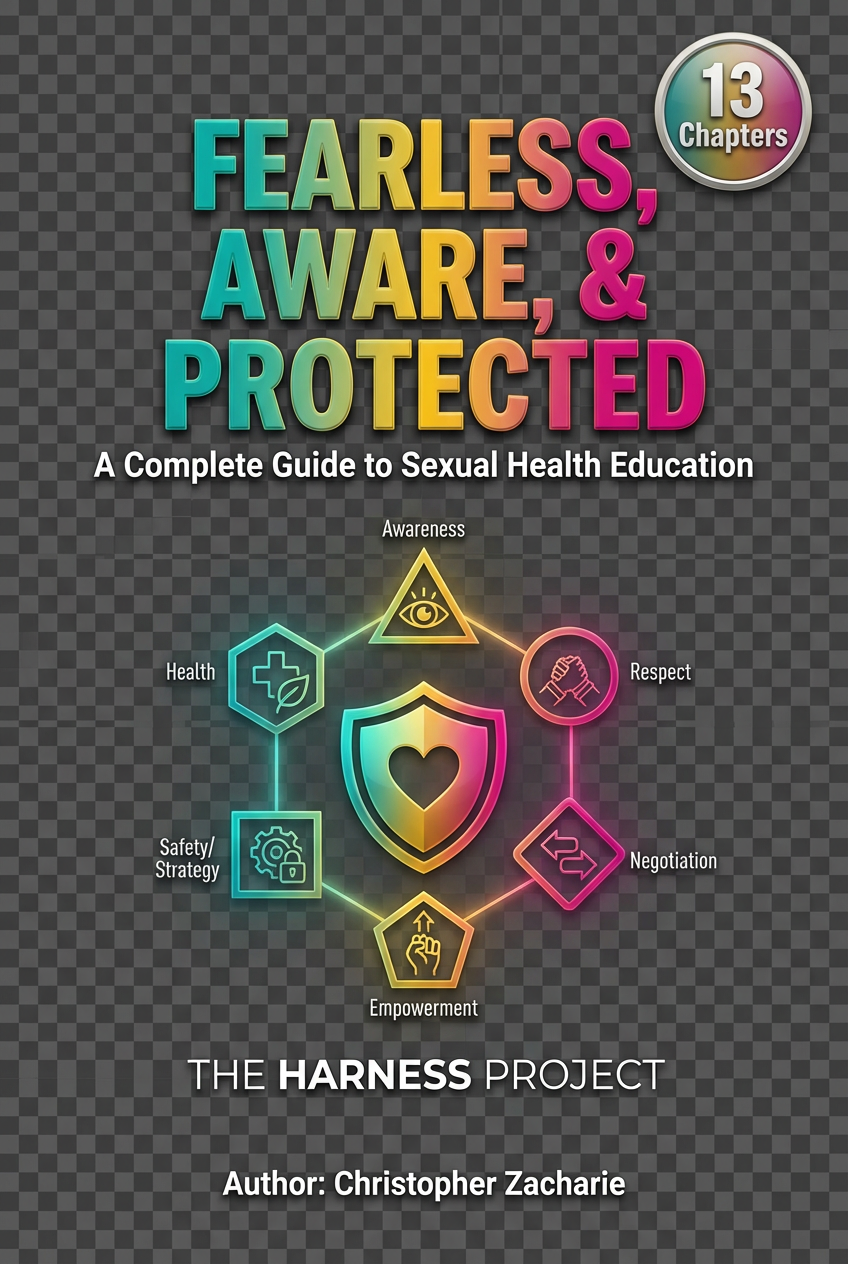
Fearless, Aware, and Protected
Table of Contents
- Introduction - Fearless, Protected, Free
- Author's Note - Why This Book Exists
- Dedication
- Part I – Mindset of Protection
- Part II – Sexual Barriers: Tools for Freedom
- Part III – Medical Shields: Pills and Shots that Protect
- Part IV – Real Talk: Navigating the Gray Areas
- Part V – Your Perfect MATCH
- Resources & Next Steps
- Closing
- Appendices
Introduction - Fearless, Protected, Free
About the Title: "Fearless, Aware, and Protected"
This title encapsulates the book's core philosophy that sexual health is about empowering people to live without fear or shame (fearless), making informed and conscious decisions about their wellbeing (aware), and adopting layered strategies that maximize safety and freedom (protected). This book is framed as a practical toolkit to inspire confidence, self-respect, and joy in sexual choices, not as a set of restrictive or fear-based rules.
This book isn't here to scare you. It's here to arm you.
Because safER sex isn't about rules and restrictions. It's about freedom — the freedom to connect, to explore, to play without shame or fear. It's about having choices you can trust, and the confidence to use them.
Inside, you'll find every tool that matters: condoms, lube, barriers, PrEP, PEP, Doxy-PEP, ART, and U=U. Old-school shields and modern science. The classics, the breakthroughs, and the strategies that real people use every day to protect themselves and their partners.
This isn't theory. It's practical. It's evidence based. It's unapologetically sex positive.
By the last page, you'll have a personal blueprint — one that fits your life, your partners, your desires. Not someone else's checklist. Yours.
So, take a breath. Set the fear aside.
You're about to learn how protection becomes power — and how your pleasure can stay fearless.
A Note on Language
This book deliberately adopts plain-language, non-judgmental terminology throughout. You'll find a comprehensive glossary with clear definitions designed for accessibility. The language used here emphasizes a sex-positive, shame-free, non-stigmatizing vocabulary, aiming to replace clinical or judgmental language with practical, respectful terms. This book explicitly avoids moralizing or lecturing, favoring empowerment, clarity, and inviting open dialogue about sexual health and boundaries.
Why "safER" Sex?
You'll notice this book uses "safER sex" instead of "safe sex." This is deliberate. The term "safER" acknowledges that perfect safety is often unrealistic and that sexual health is about creating layers of protection rather than achieving absolute safety. SafER sex represents a harm-reduction approach that's:
- Realistic - Acknowledges that life is messy and people make choices
- Flexible - Adapts to different situations, relationships, and comfort levels
- Empowering - Focuses on what you can do, not rigid rules you must follow
- Layered - Combines multiple strategies for stronger protection
"It's not perfection—it's layers of protection. Every barrier, every conversation, every choice adds strength to your safety net."
Dedication
For everyone who ever wanted answers without shame.
For everyone who deserves pleasure without fear.
For everyone who knows their body is worth protecting.
This book is for you.
Part I - Mindset of Protection
Starts With You
Protection begins in the mind before it ever shows up in action. When we choose to see safety not as fear, but as freedom, we build habits that keep us healthy, confident, and in control. A strong mindset of protection is the foundation for every decision that follows.
Chapter 1: Own Your Health
Respect yourself first; every other tool is just backup
SafER sex doesn't start with condoms or pills — it starts with you. With how you treat your body, the respect you give yourself, and the choices you make before anyone touches you. This isn't about restriction. It's about freedom: knowing you can enjoy sex without fear tagging along.
Before any tool, pill, or barrier comes into play, prevention begins with you. It's not only about reducing risks—it's about honoring your body, your desires, and your future. When you think about sexual health, most people imagine rules: Don't do this. Always do that. But safER sex isn't about fear. It's about freedom. It's knowing you can step into intimacy without carrying the weight of worry.
- Self-care is the foundation. When you take care of your body— getting tested regularly, knowing your status, staying mindful of your health—you create confidence.
- Self-love is the motivation. When you see your worth, you protect yourself not out of paranoia, but out of respect.
- SafER sex is the practice. It's not perfection—it's layers of protection. Every barrier, every conversation, every choice adds strength to your safety net.
In the chapters ahead, you'll see how condoms, PrEP, dental dams, and even open conversations with your partner fit together. None of these tools work in isolation. They're most powerful when combined. That's the essence of combination prevention: using multiple strategies to reduce risk, while keeping pleasure and connection alive.
So, before we dive into the "how-to" of condoms or the science of PrEP, pause here:
Reflection
- What does caring for your own health look like to you?
- What would change if you saw safER sex not as a restriction, but as an act of self-respect?
Takeaway
Respect yourself first — every other prevention tool is just backup.
Chapter 2: The Erotic Art of Communication
How to Start the safER sex Conversation...Say It Out Loud
Silence doesn't protect anyone. The real power move is being able to talk about what you need before things heat up. Awkward at first? Maybe. But trust me — the ability to say "let's be safe" is sexier than pretending risk doesn't exist.
If self-care is the foundation, communication is the bridge. You can own every prevention tool in the world, but if you can't talk about them with a partner, their power shrinks. Silence is risk. Conversation is protection.
Why We Avoid "The Talk"
For many people, sex is easy to do but hard to discuss. We dodge the subject because:
- We fear rejection: "What if they think I don't trust them?"
- We fear judgment: "What if they think I'm dirty for bringing this up?"
- We fear killing the mood: "What if it ruins the moment?"
But here's the truth: asking about protection, testing, or PrEP doesn't kill the mood—it builds trust. It shows that you value your partner and yourself.
Scripts That Open Doors
You don't need perfect words. You just need your words. Here are some openers that keep the conversation natural:
- Before things heat up: "Hey, before we get too into this, I want to make sure we're both safe. Have you been tested recently?"
- When you want to use a barrier: "Condoms turn me on because they mean I can relax and just enjoy."
- When exploring new things: "I'm curious about trying [fill in specific act, like fisting, rimming, etc]. What's your comfort level with that, and how can we make it safe for both of us?"
Notice these aren't lectures. They're invitations.
The Power of Listening
A safER sex talk isn't just about you laying out your terms—it's about listening, too. Ask questions, give space for answers, and notice not only what's said, but how it's said. Does your partner respect your boundaries? Do they get defensive or dismissive?
How someone responds tells you more than their test results ever could.
Consent as Conversation
Consent isn't a one-time yes—it's a continuous dialogue. Check in often:
- "Is this still good for you?"
- "Do you want to slow down?"
- "Want to switch things up?"
These check-ins make partners feel seen and safe. They also reduce misunderstandings that can harm both relationships and health.
Practice Makes Confidence
The first time you say, "Let's talk about condoms," it might feel awkward. That's normal. The more you practice, the easier it gets. Try rehearsing in a mirror or with a trusted friend. By the time you're with a partner, the words won't feel so foreign.
Reflection
- What conversations are you ready to have this week?
Takeaway
Every condom, every pill, every barrier starts with a conversation. When you can talk openly about protection, you've already made sex safER before it even begins. If you can talk about sex, you can protect yourself during it.
Part II - Sexual Barriers: Tools for Freedom
The Classics Still Work
Condoms, lube, dental dams, gloves, finger cots, toys — the barriers that keep bodies safe and pleasure high. These aren't old tricks; they're the foundation every new strategy stands on.
Chapter 3: Condoms: The Frontline
The Original—and Still Essential—Tool of safER sex
Condoms have been around for centuries. They've been mocked, misunderstood, and misused—but they remain one of the most powerful tools we have against HIV, STIs, and unintended pregnancy. Think of them as the frontline shield: simple, affordable, and—when used correctly— extremely effective.
External (Male) Condoms
These are the most common type: a thin sheath rolled over the penis before sex.
The DOs:
- DO check the expiration date
- DO open the package carefully—no teeth, scissors, or sharp nails
- DO pinch the tip before rolling down to leave space for semen
- DO use lube to prevent breakage (water- or silicone-based, never oil)
- DO hold the condom at the base during withdrawal
The DON'Ts:
- DON'T store condoms in wallets or hot cars (heat weakens latex)
- DON'T double up (two condoms = more friction = more breakage)
- DON'T reuse. Ever!!!
- DON'T mix with oil-based products (Vaseline, baby oil, Crisco—yes, people try)
Internal (Female) Condoms
Less famous, but just as effective. These are pouches worn inside the vagina or anus.
Why They're Great:
- Can be inserted hours before sex
- Cover more area around the vulva/anus, offering extra protection
- Give receptive partners more control
- Made of nitrile (not latex), so safe for people with latex allergies
How to Use:
- Squeeze the inner ring and insert like a tampon
- Ensure the outer ring rests outside the body, covering the opening
- Guide the penis (or toy) into the condom opening
Truth: That creates friction and makes both more likely to break. One condom at a time is enough.
Lambskin Condoms
Yes, they exist. Made from sheep intestine. Effective against pregnancy— but not against HIV or STIs because the pores in the material are too large. In prevention terms: not worth the risk.
Making Condoms Sexy
The biggest complaint? "They kill the mood." But that's a myth you can flip.
- Try flavored condoms for oral sex
- Experiment with ribbed or textured varieties
- Incorporate putting on the condom into foreplay. (Use your mouth, make it playful.)
- Remember: nothing kills the mood faster than stress about pregnancy or STIs. Condoms give you peace of mind—and peace of mind is sexy.
Quick Reference
- Effectiveness: ~98% with perfect use, ~85% with typical use
- Cost: Often free at clinics, cheap at drugstores, available online in bulk
- Access tip: Many community centers and LGBTQ+ clinics hand them out no questions asked
Takeaway
Condoms may not be flashy, but they work. They're the foundation every other prevention method builds on. Master them, respect them, and don't be afraid to get creative with them. Condoms aren't old-fashioned — they're timeless power moves.
Chapter 4: Beyond the Condom: SafER Oral Pleasure
Barriers for Oral Play Because Mouths Count Too
Oral sex isn't "risk-free," no matter what people tell you. Barriers like dental dams and gloves turn risky fun into smarter fun. They're not mood-killers — they're props that can actually turn up the play.
When people think of "safER sex," they usually picture penetrative acts. But HIV and other STIs can also be passed during oral sex. That's where barriers come in—tools designed to keep bodily fluids from crossing while still letting pleasure flow.
Dental Dams
A dental dam is a thin sheet of latex or polyurethane placed between the mouth and genitals or anus.
How They Work:
- Lay it flat over the vulva or anus before oral sex
- Add a bit of water-based lube on the side that touches the skin to increase sensation
- Hold it in place with your hands or your mouth while exploring
DOs:
- DO use a new one every time
- DO check for holes or tears before use
- DO store them in a cool, dry place
- DO try flavored versions for more fun
DON'Ts:
- DON'T flip it over and reuse
- DON'T use oil-based lube (it can weaken latex)
- DON'T stretch it too far (it can snap)
Gloves & Finger Cots
Hands can transmit infections too, especially when cuts or rough skin are involved. Latex or nitrile gloves (or small finger cots) add a layer of protection during fingering, fisting, or toy play.
Why Use Them:
- Prevents exchange of fluids through cuts, hangnails, or broken skin
- Reduces risk of passing infections like herpes or HPV through touch
- Keeps nails from scratching sensitive tissue
Bonus: Add lube to the glove or cot for smoother sensation and less friction.
Making Barriers Fun (Not Clinical)
The biggest misconception is that barriers kill pleasure. In reality, they can make things more playful:
- Flavored barriers turn oral sex into dessert
- Gloves can feel erotic when paired with teasing or roleplay
- Incorporating barriers signals respect and care—major turn-ons in healthy intimacy
Why It Matters
Oral sex isn't "risk-free." Gonorrhea, chlamydia, herpes, syphilis, HPV, and (rarely) HIV can spread this way. Using barriers turns "risky fun" into safER fun.
Takeaway
Barriers for oral and manual play are a sign of respect for your partner's health and your own. They are not mood-killers; they are pleasure-enhancers.
Chapter 5: Lube & Toys
Pleasure and protection go hand in hand
Lube isn't just for when things get dry. It is a vital tool for safER sex that prevents friction, reduces the risk of condom breakage, and makes everything feel better. Toys are not just for solo play; they are excellent tools for exploring pleasure with a partner, and they need to be protected and cleaned just like any other part of your safER sex routine.
Lube: Your Best Friend in SafER Sex
Think of lube as the unsung hero of your sex life. It's not a sign of failure; it's a sign of intelligence and a commitment to pleasure.
Why Lube Matters:
- Reduces Friction: Less friction means less chance of micro-tears in the skin or condom, which are potential entry points for STIs
- Prevents Condom Breakage: A dry condom is a weak condom. Lube keeps the latex strong and elastic
- Enhances Pleasure: Sex should feel good. Lube makes it smoother, easier, and more enjoyable for everyone involved
The Three Types of Lube
| Lube Type | Best For | NEVER Use With | Quick Tip |
|---|---|---|---|
| Water-Based | Condoms, toys, all types of sex | Nothing, it's universally safe | Reapply often, as it dries out quickly |
| Silicone-Based | Water play, anal sex, long sessions | Silicone toys (it degrades them) | Very slick and lasts a long time |
| Oil-Based | Massage, external play | Latex condoms (it breaks them down) | Only use with non-latex barriers |
Toys: Playtime with Protection
Whether you're using a vibrator, a dildo, or a butt plug, toys are part of your sex life, and they need to be treated with the same safER sex care as your body.
Toy Safety Checklist:
Takeaway
Lube and toys are essential parts of a pleasure-focused, safER sex life. Don't let a lack of lubrication or a dirty toy be the thing that introduces risk. Prioritize pleasure, and protection will follow.
Part III - Medical Shields: Pills and Shots that Protect
Science as a Wingman
Medicine has changed the game. Pills that stop HIV before it starts. Treatments that make transmission impossible. Even antibiotics that block STIs after sex. Knowledge + science = power. Condoms and barriers are classics, but HIV prevention has evolved far beyond latex. Today, medicine itself has become a prevention tool. Pills, shots, and treatments don't just save lives—they also reduce transmission and empower people to take charge of their sexual health like never before.
Chapter 6: PrEP: Prevention in a Pill
Armor You Take
PrEP (Pre-Exposure Prophylaxis) is one of the most powerful medical tools in the modern safER sex toolkit. It is a daily pill taken by HIV-negative people to prevent them from contracting HIV. Think of it as a daily armor that, when taken consistently, provides a highly effective barrier against the virus.
How PrEP Works
PrEP medications contain two drugs that are also used to treat HIV. When taken regularly, these drugs build up a protective shield in the body. If HIV enters the bloodstream, the medication prevents the virus from replicating and establishing a permanent infection.
Effectiveness: The Power of Consistency
- Sexual Transmission: When taken as prescribed, PrEP is over 99% effective at preventing HIV through sex
- Injection Drug Use: PrEP is at least 74% effective at preventing HIV among people who inject drugs
Who Should Consider PrEP?
PrEP is recommended for anyone who is HIV-negative and at a higher risk of contracting HIV. This includes people who:
- Have an HIV-positive partner who is not virally suppressed (U=U)
- Do not consistently use condoms
- Have been diagnosed with an STI in the past six months
- Use injection drugs
Getting Started with PrEP
- Talk to Your Doctor: PrEP requires a prescription. You will need to discuss your sexual history and lifestyle
- Get Tested: You must be confirmed HIV-negative before starting PrEP. You will also be tested for Hepatitis B and kidney function
- Regular Follow-Up: Once on PrEP, you will need to see your doctor every three months for follow-up HIV tests, STI screenings, and prescription refills
PrEP is Not a Substitute for Condoms
It is essential to remember that PrEP only protects against HIV. It does not protect against other STIs (like syphilis, gonorrhea, chlamydia, or HPV) or prevent pregnancy. For comprehensive safER sex, PrEP is best used in combination with condoms and regular STI testing.
Takeaway
PrEP is a revolutionary tool that puts the power of HIV prevention directly into your hands. It is a choice that allows you to pursue pleasure with confidence and significantly reduce your risk of contracting HIV. Talk to your doctor—it could be the most important safER sex decision you make.
Chapter 7: PEP: The 72-Hour Window
The Emergency Play
PEP (Post-Exposure Prophylaxis) is the emergency brake in your safER sex toolkit. It is a course of medication taken after a potential exposure to HIV to prevent the virus from taking hold. It is not a substitute for regular prevention methods like PrEP or condoms, but it is a vital safety net for those moments when things don't go as planned.
The 72-Hour Window
The most critical thing to know about PEP is the time limit: it must be started within 72 hours (three days) of the potential exposure. The sooner you start, the more effective it is. Every hour counts. If you think you've been exposed to HIV, do not wait.
When to Consider PEP
PEP is typically prescribed after:
- Unprotected sex with a partner whose HIV status is unknown or positive and who is not virally suppressed (U=U)
- Condom breakage or slippage with a partner whose status is unknown or positive
- Sharing needles or works for injection drug use
- Sexual assault
How to Get PEP
PEP is a prescription medication. You can get it from:
- Emergency rooms (ERs)
- Urgent care clinics
- Sexual health clinics
- Your primary care provider
What to Expect
- Testing: You will be tested for HIV before starting PEP to confirm you are negative
- The Course: PEP involves taking a combination of HIV medications once or twice daily for 28 consecutive days
- Side Effects: Like any medication, PEP can have side effects, such as nausea or fatigue. Your doctor can help manage these
- Follow-Up: You will need follow-up HIV testing after you complete the 28-day course, typically at 4 weeks and 3 months
PEP IS NOT PrEP
It is important to understand the difference:
- PrEP is taken before exposure to prevent HIV. It is for ongoing prevention
- PEP is taken after exposure to stop HIV from establishing itself. It is for emergency use only
If you find yourself using PEP more than once, it is a strong signal that you should talk to your doctor about starting PrEP for a more consistent, long-term prevention strategy.
Takeaway
PEP is a powerful second chance. Know the 72-hour window, know where to get it, and don't hesitate to use it. It is a critical part of the modern safER sex landscape.
Chapter 8: Doxy-PEP: A New Tool in your Toolkit
A New Layer Against STIs
Doxy-PEP (Doxycycline Post-Exposure Prophylaxis) is one of the newest and most promising tools in the safER sex toolkit. It is an antibiotic taken after sex that significantly reduces the risk of acquiring bacterial STIs, specifically syphilis, chlamydia, and gonorrhea.
How Doxy-PEP Works
Doxy-PEP involves taking a single, high dose of the antibiotic doxycycline (200mg) within 72 hours (three days) after having condomless sex. The antibiotic works by killing any newly acquired bacteria that cause syphilis and chlamydia before they can establish an infection.
Effectiveness and Recommendations
Clinical trials have shown Doxy-PEP to be highly effective:
- Syphilis: Reduced risk by over 70%
- Chlamydia: Reduced risk by over 70%
Who is Doxy-PEP for?
Doxy-PEP is currently recommended for people who are at high risk of acquiring these bacterial STIs, such as:
- HIV-negative men who have sex with men (MSM) and transgender women who have had a bacterial STI in the past year
- People living with HIV who have had a bacterial STI in the past year
Doxy-PEP is Not a Silver Bullet
It is crucial to understand the limitations of Doxy-PEP:
- It only targets bacterial STIs: It does not protect against viral STIs (like HIV, HPV, or Herpes) or prevent pregnancy. Recent studies show that it does not protect against Gonorrhea
- Antibiotic Resistance: There is a concern that widespread use could lead to increased antibiotic resistance, especially for gonorrhea. This is why it is currently recommended only for high-risk individuals
- Regular Testing is Still Required: Even with Doxy-PEP, regular STI screening every three months is still the standard of care
The New Combination Prevention
Doxy-PEP is a powerful addition to the combination prevention strategy:
- PrEP for HIV prevention
- Condoms for broader STI and pregnancy prevention
- Doxy-PEP for targeted bacterial STI prevention
Takeaway
Doxy-PEP is a game-changer for those at high risk of bacterial STIs, offering a new layer of protection. Talk to your sexual health provider to see if Doxy-PEP is right for you and remember that it works best when combined with regular testing and open communication.
Chapter 9: ART: A Work of ART
The Science that Rewrites the Story
ART (Antiretroviral Therapy) is the medical treatment for people living with HIV. It is a combination of medications that, when taken daily as prescribed, suppresses the amount of HIV in the body to an undetectable level. This is the science that has transformed HIV from a death sentence into a manageable chronic condition.
The Power of Undetectable (U=U)
The most profound outcome of effective ART is achieving an Undetectable Viral Load. This is the foundation of the globally recognized and scientifically proven message: Undetectable Equals Untransmittable (U=U).
What U=U means:
- A person living with HIV who is on ART and has an undetectable viral load cannot sexually transmit HIV to a partner
- This is not a theory or a hope; it is a fact confirmed by multiple large-scale studies
- U=U removes the fear and stigma associated with HIV transmission, allowing people living with HIV to have sex with confidence and without the need for condoms for HIV prevention
Taking Your ART
Consistency is Key:
- ART must be taken every day exactly as prescribed by your doctor. Missing doses can allow the virus to multiply and become resistant to the medication
- Your doctor will monitor your viral load with regular blood tests. The goal is to keep the viral load so low that it is undetectable
Treatment as Prevention (TasP)
ART is a powerful form of combination prevention. Not only does it keep the person living with HIV healthy, but it also acts as a public health tool by preventing new transmissions.
Disclosing Your Status with Confidence
The U=U message empowers people living with HIV to disclose their status to partners with confidence. You can share the scientific fact that there is zero risk of sexual transmission. This is a massive shift from the fear-based narratives of the past.
Takeaway
ART is a medical marvel that saves lives and prevents new infections. For those living with HIV, it is the path to health, freedom, and the ability to say with absolute certainty: Undetectable Equals Untransmittable (U=U). This is the ultimate form of safER sex for a serodiscordant couple (where one partner is HIV-positive and the other is HIV-negative).
Testing as Empowerment
- HIV testing is not about fear—it's about clarity
- Knowing your status allows you to make informed decisions, protect yourself and your partners, and reduce anxiety
Recommended Frequency
- Every 3–6 months if you're sexually active with multiple partners
- Annually if your risk is lower
Why It Matters?
- Ends stigma: People with HIV who are undetectable are not "a risk"
- Encourages treatment adherence
- Creates healthier, safer communities
Beyond HIV
Testing for STIs like chlamydia, gonorrhea, and syphilis is also crucial. Many are silent (no symptoms), but all are treatable. Early testing = easy solutions.
Part III Takeaway
Modern prevention isn't just about barriers—it's about medicine, technology, and knowledge. Whether it's taking PrEP daily, rushing for PEP or Doxy-PEP after an accident, or understanding that U=U is a fact, we now have more tools than ever to stop HIV in its tracks. Prevention isn't about one choice—it's about layering options to build your strongest safety net.